Free Medical Chronology Templates You Can Download Today Plus AI Tools That Replace Them
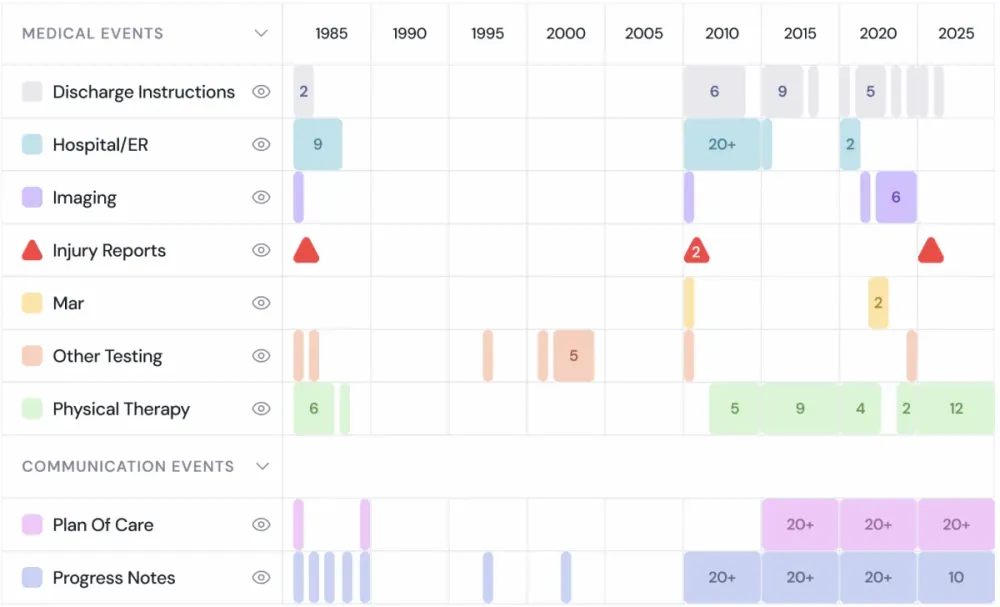
If you’re a legal nurse consultant, paralegal, or claims adjuster, you’ve spent countless hours building medical chronologies from scratch. The process is time-consuming, tedious, and prone to human error when dealing with hundreds of pages of medical records.
This guide provides free medical chronology templates you can use immediately, plus a practical look at how AI-powered tools are changing the game for legal and insurance professionals in 2026.
What Is a Medical Chronology?
A medical chronology is a structured timeline of a patient’s medical history, organized chronologically to help attorneys, adjusters, and medical reviewers quickly understand the sequence of treatments, diagnoses, and events in a legal case.
Medical chronologies are essential in:
- Workers’ compensation claims
- Personal injury litigation
- Medical malpractice cases
- Social Security Disability claims
- Life care planning and MSA (Medicare Set-Aside) preparation
The problem: Creating a comprehensive medical chronology manually takes 10-20 hours per case when you’re working with complex medical records spanning multiple providers.
Free Medical Chronology Template (Download)
Basic Medical Chronology Template (Excel/Google Sheets)
Here’s a simple template structure you can copy:
| Date | Provider | Type of Visit | Treatment/Diagnosis | Page Reference |
|---|---|---|---|---|
| 01/15/2023 | Dr. Smith, Orthopedic | Office Visit | Evaluated lower back pain, ordered MRI | Pages 45-47 |
| 01/22/2023 | Regional Imaging Center | MRI | Lumbar spine MRI - herniated disc L4-L5 | Pages 52-54 |
| 02/03/2023 | Dr. Smith, Orthopedic | Follow-up | Reviewed MRI results, prescribed physical therapy | Pages 58-60 |
Columns to include:
- Date: Date of service (MM/DD/YYYY format)
- Provider: Doctor name, facility, or medical professional
- Type of Visit: Office visit, ER visit, surgery, diagnostic test, therapy session
- Treatment/Diagnosis: What happened during this visit (diagnosis, procedure, medication prescribed)
- Page Reference: Where this information appears in the medical records (critical for verification)
Optional columns for complex cases:
- ICD-10 codes
- CPT codes
- Medications prescribed/administered
- Physician specialty
- Body part treated
- Causation notes (related to injury vs. pre-existing condition)
[Download Free Medical Chronology Template - Excel] [Download Free Medical Chronology Template - Google Sheets]
Medical Chronology Sample (Workers’ Compensation Case)
Here’s what a completed medical chronology looks like for a workers’ compensation back injury claim:
Sample Medical Chronology: Lower Back Injury Case
Claimant: John Doe
Date of Injury: 12/10/2022
Claim Type: Workers’ Compensation - Lower Back Injury
Total Pages Reviewed: 487 pages
| Date | Provider | Type of Visit | Treatment/Diagnosis | Causation | Page Ref |
|---|---|---|---|---|---|
| 12/10/2022 | Occupational Health Clinic | Initial Injury Visit | Acute lumbar strain, prescribed NSAIDs and work restrictions | Related to 12/10 injury | 1-4 |
| 12/15/2022 | Dr. Martinez, Orthopedic | Referral Consultation | Physical exam, ordered lumbar X-ray | Related | 12-15 |
| 12/20/2022 | Radiology Associates | X-ray | Lumbar spine X-ray - no fracture, mild degenerative changes | Related (acute on chronic) | 18-20 |
| 01/05/2023 | Physical Therapy Center | PT Evaluation | Baseline assessment, ROM limitations noted | Related | 25-28 |
| 01/10/2023 - 03/15/2023 | Physical Therapy Center | PT Sessions (18 visits) | Progressive strengthening and mobility exercises | Related | 30-95 |
| 03/20/2023 | Dr. Martinez, Orthopedic | Follow-up | Persistent pain, ordered MRI | Related | 98-101 |
| 04/02/2023 | Advanced Imaging | MRI | Lumbar MRI - herniated disc L4-L5, moderate canal stenosis | Related | 105-108 |
| 04/15/2023 | Dr. Chen, Pain Management | Referral | Epidural steroid injection recommended | Related | 112-116 |
| 05/01/2023 | Ambulatory Surgery Center | Procedure | L4-L5 epidural steroid injection performed | Related | 120-125 |
Key findings:
- Injury date: 12/10/2022 (workplace lifting incident)
- Primary diagnosis: Lumbar disc herniation L4-L5
- Treatment timeline: 5 months from injury to epidural injection
- Total medical visits: 24 encounters
- Causation: All treatment related to 12/10/2022 work injury
This is what a manual chronology looks like - and it took approximately 8-12 hours to create from 487 pages of records.
How to Create a Medical Chronology (Step-by-Step)
Step 1: Organize Medical Records
Before you start building the chronology:
- Remove duplicates (medical records often contain duplicate pages)
- Organize records by date (oldest to newest)
- Separate records by provider if dealing with multiple facilities
- Number all pages sequentially (this becomes your page reference)
Step 2: Extract Key Information
For each medical encounter, identify:
- Date of service (look for “Date of Visit” or “DOS”)
- Provider name and specialty
- Chief complaint (why the patient came in)
- Diagnosis (ICD-10 codes often listed)
- Treatment provided (medications, procedures, referrals)
- Relevant test results (labs, imaging, diagnostics)
Step 3: Build the Timeline
Enter information into your template chronologically:
- Start with the date of injury or first medical encounter
- Add each subsequent visit in order
- Include gaps in treatment (important for claims evaluation)
- Note when new providers or specialists enter the picture
Step 4: Quality Control
Before finalizing:
- Verify all dates are accurate
- Check that page references are correct
- Ensure no critical visits are missing
- Review for consistency in terminology
- Proofread for typos and formatting
Reality check: This process takes 10-20 hours for a complex case with 300-500 pages of records. For cases with 1,000+ pages, you’re looking at 30-40 hours of manual work.
The Problem with Manual Medical Chronologies
While templates help standardize the format, the manual chronology process has significant limitations:
Time-Intensive
- 10-20 hours per case for experienced legal nurse consultants
- Longer for paralegals or adjusters without medical background
- Delays case progression while waiting for chronology completion
Expensive
- Legal nurse consultants charge $150-300/hour
- Outsourced chronology services cost $2-5 per page
- A 500-page case can cost $1,000-2,500 just for the chronology
Error-Prone
- Easy to miss critical details in lengthy records
- Human fatigue leads to inconsistencies
- Difficult to verify accuracy without re-reviewing all records
Scalability Issues
- Adjusters managing 150+ open claims can’t create chronologies for every case
- Law firms handling high volumes must choose which cases get detailed chronologies
- Backlogs develop during high-volume periods
AI-Powered Medical Chronology Tools: What’s Changed in 2026
The question isn’t whether to use AI for medical chronologies - it’s how to do it strategically.
AI-powered platforms can now:
- Process 500 pages of medical records in minutes (vs. 10-20 hours manually)
- Extract structured data (dates, providers, diagnoses, procedures, medications)
- Generate chronologies with page references automatically
- Identify gaps in treatment or missing records
- Flag pre-existing conditions vs. injury-related treatment
How AI Medical Chronology Tools Work
- Document Ingestion: Upload PDFs (even messy, scanned, rotated records)
- OCR & Cleanup: AI extracts text from images and cleans up formatting
- Medical Entity Recognition: AI identifies dates, providers, diagnoses, procedures, medications
- Chronological Organization: Events are sorted by date automatically
- Output Generation: Chronology exported in Excel, Word, or PDF format
What AI Does Better Than Humans
- Speed: Minutes instead of hours
- Consistency: Same format and detail level across all cases
- Completeness: Doesn’t skip pages due to fatigue
- Structured Data: Extracts ICD-10s, CPTs, medications in searchable format
What Humans Still Do Better
- Causation Analysis: Determining if treatment is related to the injury requires medical-legal judgment
- Clinical Context: Understanding significance of findings in the context of the case
- Quality Review: Verifying AI output is accurate and complete
- Strategic Decision-Making: Deciding which details matter for case strategy
The Inverted Ratio: AI should prepare the chronology, humans should review and refine it. This is faster and more cost-effective than either approach alone.
When to Use Templates vs. AI Tools
Use a Manual Template When:
✅ You have fewer than 50 pages of records
✅ The case is straightforward with limited medical history
✅ You’re working on a one-off case and don’t need volume processing
✅ Budget is extremely tight and you have time to spare
Use AI-Powered Tools When:
✅ You’re processing 100+ pages of records per case
✅ You handle high volumes (10+ cases per month)
✅ You need same-day turnaround
✅ You want structured data (ICD-10s, CPTs) for analytics
✅ You’re managing 150+ open claims and need to triage cases quickly
Hybrid Approach (Best Practice):
Many legal and insurance teams are adopting a hybrid model:
- Use AI to generate the initial chronology (saves 80% of time)
- Review and refine the AI output (adds medical-legal judgment)
- Use the extra time for case strategy instead of data entry
Cost comparison:
- Manual chronology: $1,500-2,500 per case (outsourced) or 10-20 hours internal time
- AI-powered chronology: $200-500 per case + 1-2 hours review time
- Savings: 60-70% cost reduction, 80-90% time reduction
How to Evaluate AI Medical Chronology Software
If you’re considering AI tools, here are the key questions to ask vendors:
1. Accuracy & Reliability
- What is the accuracy rate for date extraction? Diagnosis extraction?
- How does the AI handle handwritten notes or poor-quality scans?
- Can I verify AI outputs against source documents easily?
2. Output Format
- Can I customize the chronology format to match my firm’s standards?
- Does it export to Excel, Word, PDF?
- Can I add my own notes or causation analysis?
3. Integration & Workflow
- Does it integrate with my case management system (Filevine, Litify, CASEpeer)?
- Can I upload records directly from my document management system?
- What’s the turnaround time from upload to completed chronology?
4. Pricing & Volume
- Is pricing per page, per case, or subscription-based?
- Are there volume discounts for high-volume users?
- What’s included in the base price vs. add-ons?
5. Support & Responsiveness
- What happens if the AI makes an error?
- How quickly can issues be fixed?
- Is there a dedicated support team or account manager?
Red flag: Vendors who claim “100% accuracy” or “replaces all manual review.” AI is a tool to augment human expertise, not replace it.
Medical Chronology Best Practices (Manual or AI)
1. Always Include Page References
Every entry should cite the source page number. This allows:
- Verification of accuracy
- Quick reference during depositions or settlement negotiations
- Defensibility if opposing counsel challenges the chronology
2. Use Consistent Terminology
- Stick to medical terminology from the records (don’t paraphrase unnecessarily)
- Use standard abbreviations (e.g., “PT” for physical therapy, “MRI” for magnetic resonance imaging)
- Define acronyms the first time they appear
3. Separate Objective Facts from Subjective Analysis
- Objective: “MRI showed herniated disc at L4-L5” (fact from record)
- Subjective: “Herniation likely caused by 12/10 lifting incident” (your analysis)
Keep these separate so readers can distinguish between documented facts and professional opinions.
4. Highlight Gaps in Treatment
Note when there are significant gaps:
- “No medical treatment between 03/15/2023 and 06/01/2023 (77-day gap)”
Gaps can be significant for claims evaluation (Did the claimant stop treating? Was the injury not as severe as claimed?).
5. Include Relevant Negatives
Sometimes what’s NOT in the records is important:
- “No mention of prior back injuries in medical history”
- “No opioid prescriptions documented”
- “Patient denied alcohol or tobacco use”
Common Medical Chronology Mistakes to Avoid
❌ Missing Page References: Makes verification impossible
❌ Inconsistent Date Formats: Use MM/DD/YYYY throughout
❌ Skipping Duplicate Records: Note duplicates but don’t skip verification
❌ Ignoring Pre-Existing Conditions: These are critical for causation analysis
❌ Summarizing Too Much: Include enough detail to be useful
❌ Not Flagging Discrepancies: Note when records contradict each other
❌ Forgetting to Update: Add new records as they come in
The Future of Medical Chronologies: What’s Next
The medical-legal industry is moving toward:
Structured Data Extraction
Beyond chronologies, AI is extracting:
- ICD-10 diagnosis codes
- CPT procedure codes
- Medication lists with dosages and dates
- Provider networks and referral patterns
- Treatment cost data
This structured data enables:
- Predictive analytics (case value estimation)
- Benchmarking (comparing similar cases)
- Compliance reporting (Medicare Set-Asides, life care plans)
Real-Time Chronology Updates
As new medical records arrive, AI can automatically:
- Add new entries to existing chronologies
- Flag discrepancies with prior records
- Alert adjusters or attorneys to significant new findings
Integration with Case Management
Chronologies will live inside case management systems (Filevine, Litify, CASEpeer), not as separate Excel files:
- Click a chronology entry to view the source document page
- Filter chronologies by provider, diagnosis, or date range
- Generate reports for specific time periods
Conclusion: Templates Are a Starting Point, Not the Finish Line
Free medical chronology templates are valuable for simple cases and low-volume users. But if you’re processing medical records regularly, the economics of AI-powered tools are compelling:
- 60-70% cost reduction vs. outsourced chronology services
- 80-90% time savings vs. manual chronology creation
- Same-day turnaround vs. 2-4 week wait times
- Structured data that enables analytics and reporting
The question isn’t whether AI will replace manual chronologies - it already has for high-volume users. The question is whether your team will adopt these tools strategically or continue spending 10-20 hours per case on work that can be automated.
Next steps:
- Download the free template and try it on your next simple case
- Track how long it takes to create a chronology manually (be honest about the time investment)
- Calculate the cost: Hours spent × your hourly rate (or $150-300/hour for outsourced work)
- Pilot an AI tool on 5-10 cases and compare the results
- Make a strategic decision: Manual, AI-assisted, or hybrid approach
The legal and insurance professionals seeing the most success aren’t choosing between templates and AI - they’re using both strategically based on case complexity and volume.
About InQuery: InQuery is an AI-powered platform that helps legal and insurance professionals transform medical record review from weeks of manual work into minutes of comprehensive analysis. Our platform handles document cleanup, indexing, structured data extraction, and chronology generation with 24-hour SLA performance. Learn more at inquery.ai.
Frequently Asked Questions
Q: How long does it take to create a medical chronology manually?
A: For experienced legal nurse consultants, 10-20 hours per case with 300-500 pages of records. For less experienced staff, 20-30 hours is common.
Q: What’s the difference between a medical chronology and a medical summary?
A: A chronology is a date-ordered timeline of medical events. A summary is a narrative overview of the medical history, often organized by body system or medical issue rather than chronologically.
Q: Can I use AI tools for IME (Independent Medical Examination) preparation?
A: Yes. AI-generated chronologies are commonly used to prepare for IMEs, providing the examining physician with a comprehensive timeline of treatment.
Q: Are AI-generated chronologies admissible in court?
A: The chronology itself is a work product, not evidence. What matters is the accuracy of the information extracted from the medical records. AI tools should include page references so any entry can be verified against source documents.
Q: How much do outsourced medical chronology services cost?
A: Typically $2-5 per page, with 2-4 week turnaround times. A 500-page case would cost $1,000-2,500.
Q: What’s the best format for a medical chronology - Excel or Word?
A: Excel (or Google Sheets) is preferred because it allows sorting, filtering, and easier updates. Word is better for narrative summaries.

Erick Enriquez
CEO & Co-Founder at InQuery